Google began as a dorm-room experiment — a simple idea crafted by two students who wanted to organize the world’s information. But what followed was a journey so powerful that it reshaped how humanity thinks, learns, works, and dreams. From a tiny search box to an empire that includes Maps, Android, YouTube, Gmail, and AI, Google became not just a company but a daily habit for billions. This blog explores Google’s rise with emotional depth, business clarity, and a storytelling style that feels human and reflective — the kind that turns a tech timeline into a cinematic journey of innovation and intention.
When two Stanford students — Larry Page and Sergey Brin — first met in 1995, they didn’t imagine building one of the world’s most influential companies. In fact, they initially clashed. Larry found Sergey intense; Sergey found Larry overly analytical. Yet, beneath the friction was a shared curiosity — a belief that the internet was growing too fast and information was becoming too scattered. People needed a way to truly find what mattered.
Together, they began building a project called BackRub — a search system that ranked web pages based on how many other pages linked to them. This “link analysis” became the foundation of PageRank, a revolutionary idea at the time. Instead of guessing what users wanted, their system relied on the collective wisdom of the internet to bring forward the most trusted results.
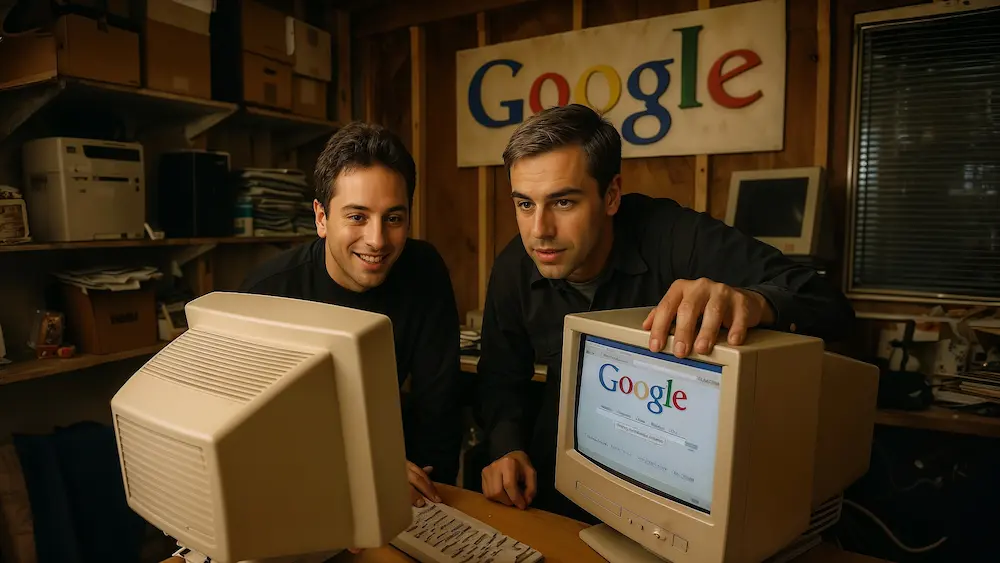
This is an AI-generated image — not a real historical photo.
In 1998, they renamed their project Google, a playful twist on googol, the number 1 followed by 100 zeros — symbolizing their mission to make vast information accessible. They set up office in a friend’s garage, armed with second-hand computers, an outdated server, and a dream that felt too large for the space they were working in.
But Google didn’t rise because of technology alone. It rose because it made the internet feel simple. A blank white page. A single search bar. No clutter. No noise. Just curiosity and answers — a design philosophy that still defines the brand.
As the 2000s unfolded, Google evolved from search engine to necessity. Gmail arrived with free storage that felt unreal at the time. Google Maps transformed travel, making everyone feel like they carried a personal guide in their pocket. Android democratized smartphones. YouTube, acquired in 2006, became the world’s video library — the home of creators, educators, entertainers, and dreamers.
And behind every product was a deeper promise:
“Make life easier, faster, and more connected.”
Google didn’t just build tools — it built the infrastructure of the digital age. Businesses relied on Google Ads, students relied on Google Search, and families relied on Google Photos to preserve memories. It became the quiet engine powering the world.
But no story this large escapes controversy. As Google’s influence grew, questions emerged about privacy, data, and monopoly power. Critics argued that the company had too much control over information flow. Governments launched investigations. Users worried about how their data was used. For a company built on accessibility and trust, this was a complex challenge.
Yet, what kept Google present in daily life wasn’t perfection — it was relevance. The company kept adapting. It moved into AI research, cloud computing, and voice assistants. Tools like Google Assistant, Pixel phones, and AI-powered services reshaped how people interacted with technology.
At the heart of Google’s evolution was a constant theme: curiosity. Larry and Sergey eventually stepped back, but their core philosophy remained — innovation with purpose.
Even today, Google continues to push boundaries. Its AI research influences medicine, energy efficiency, language processing, and climate studies. Its products power classrooms, small businesses, and creators across the world. The company isn’t without challenges, but its impact is undeniable — Google became the bridge between human questions and global knowledge.
What truly sets Google apart is how deeply it has woven itself into everyday moments. From “How to cook rice” to “How to start a business,” from maps that guide lost travelers to translation tools that dissolve language barriers — Google became a quiet companion to billions of lives.
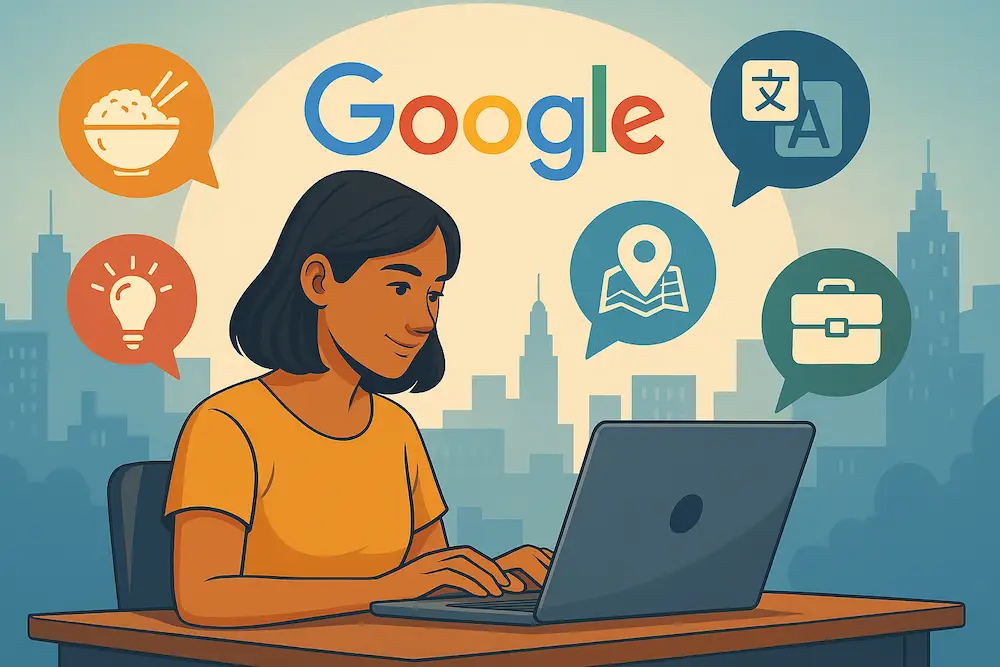
More than a brand, it became a verb: Just Google it.
Few companies in history have ever reached that level of cultural presence.
What We Can Learn
Google’s journey teaches us that world-changing ideas often start in small rooms with big questions. It shows that innovation isn’t about complexity — it’s about clarity. The company grew not because it wanted to be powerful, but because it solved real problems with simplicity and purpose.
Yes, it faces challenges and responsibility. But its story remains a lesson in curiosity-driven growth, daring ambition, and the belief that information should be empowering, not overwhelming.
In the end, Google reminds us that the search for answers — in life, business, or dreams — is always possible when you build with intention and keep learning along the way.