Five years after a massive flood erased an entire city and left it frozen in time, two YouTubers, Arjun and Yaswanth, decide to spend seven days inside the abandoned ruins to document the truth behind the haunting rumors that surround it. What starts as a bold challenge slowly becomes a psychological and spiritual struggle as strange events unfold near two mysterious graves in an old cemetery. The deeper they go into the silence of the dead city, the more they realize that some places do not forget—and some call out to the living in ways no camera can truly capture.
The city had no name anymore. At least, not one people spoke. Before the flood, it had been a bustling place full of markets, children, traffic horns, street-light reflections, and endless noise. But nature decided differently one monsoon night, when a violent flood tore through its heart, swallowing homes, bending bridges, and pulling life completely under its dark waves. Those who survived fled forever, leaving behind a drowning silence that settled on the buildings like a second skin. Five years had passed since then. The water had receded, but no one returned. People claimed the city wasn’t entirely empty. They said it breathed differently. They said it listened. They said if you stood near the cemetery at midnight, you could hear a soft humming that wasn’t wind or water. The story of the two graves—side by side, untouched by the flood—became folklore, something people whispered about but refused to investigate. Whether it was fear, superstition, or plain human instinct, no one dared step foot there again.
No one except Arjun and Yaswanth.
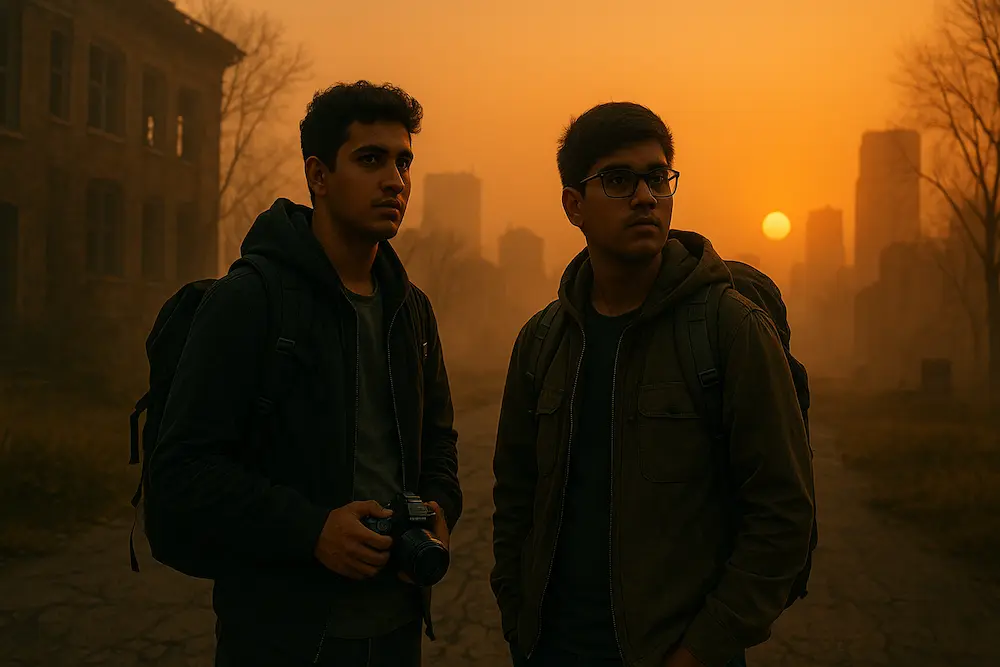
They were not thrill-seekers by nature, just two young men with a dream of growing their YouTube channel. Their content had always been simple: abandoned buildings, small adventures, local mysteries. But they wanted something bigger, something that would set them apart, something that would give them an identity in a sea of creators. When the idea of surviving seven days in the dead city came up, Arjun said it casually, almost jokingly. Yet the moment the words left his mouth, they hung in the air with a strange weight, as if the universe paused to hear what would happen next. Yaswanth felt a chill right then. He tried laughing it off, but deep down he knew Arjun meant it. That was how Arjun was—sharp, determined, a little reckless, but always calculating the outcome. Yaswanth admired him and feared for him in equal measure. But friendship does strange things to courage. So after a week of preparation, planning, and gathering gear, the two packed their bags, charged their cameras, and stepped into the city that the world had silently buried.
The first thing they noticed upon entering was the stillness. It wasn’t the regular kind of quiet you hear in small towns or deserted roads. This silence felt alive, layered, as if it contained echoes waiting to be released. Yaswanth felt it first—a subtle tension in his chest, the sensation of being watched by something patient. Arjun sensed it too, but he pushed the feeling down and raised his camera, narrating their entry with a practiced voice. The sun was setting, casting long shadows across the broken buildings. The flood had left marks everywhere—cracked walls, bent poles, overturned cars half-buried in mud. Trees had grown wildly, reclaiming the streets with roots that broke through concrete like nature’s reminders of power. The atmosphere was heavy, a blend of abandonment and reluctant beauty, the kind that makes you stare despite discomfort.
Their destination for the first night was the old school building near the cemetery. Locals had warned them never to go near the two graves, but of course, that was precisely why they chose to stay close. The school itself looked like a skeleton—walls stripped of paint, glass windows shattered, desks thrown around as if children had run in panic. There were signs of animals at some point, though none were around now. A few bones were scattered in the corners, likely from old stray dogs or goats caught in the flood’s aftermath. Nothing dangerous, but unsettling nonetheless. Yaswanth wanted to set up their camp in one of the classrooms, but Arjun insisted on using the one that had the clearest view of the cemetery. That, after all, was where the story truly lived.
The first night wasn’t dramatic in terms of physical activity, but the psychological weight settled strongly on both of them. They sat near the entrance, recording their commentary as darkness swallowed the city. The cemetery lay about thirty meters away, partly hidden by a broken gate and tall grass. The two graves were visible even in the dim moonlight—two stone slabs, side by side, untouched by nature’s wrath. It didn’t make sense to Arjun. Everything around them had been bent, broken, or washed away, yet those graves looked like they were placed gently by someone who cared. Yaswanth kept glancing at them nervously, as if expecting them to shift or glow. But nothing happened. At least, nothing they could point to. Just after midnight, as they were preparing to sleep, a faint humming drifted through the air. It was low, almost musical, but not human. It felt like a vibration, something that moved through the bones rather than ears. Arjun froze for a moment, trying to capture it on camera, but the audio picked up only static. They exchanged looks, unsure whether they imagined it or truly heard it. The humming faded as quietly as it came. They wrapped themselves in their blankets and slept uneasily.
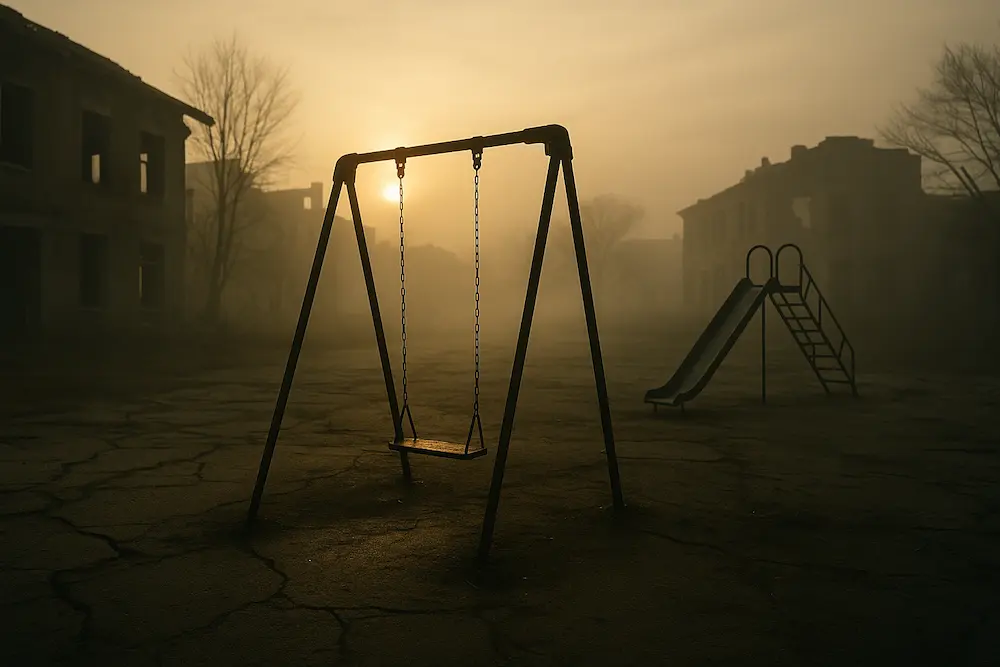
Morning came with a strange brightness. The city looked different—not alive but not fully dead either. Arjun stepped out first, eager to document everything. Yaswanth followed, rubbing his arms as if cold despite the sun. They spent the day exploring, filming broken shops, collapsed houses, and an eerily intact playground where a rusty swing still swayed despite the absent wind. Whenever the camera wasn’t rolling, Yaswanth found himself glancing back toward the graves, and whenever Arjun brought it up, Yaswanth said he was just being cautious. But Arjun knew his friend well. He knew fear when he saw it.
That night, the humming returned. Louder this time. Yaswanth woke up sweating and sat bolt upright. Arjun tried calming him down, reminding him that strange sounds weren’t unusual in old places. But something about the way the sound lingered around the graves made Arjun feel uneasy as well. Yaswanth didn’t sleep the rest of the night. He just stared into the darkness, whispering that something felt wrong. Arjun stayed awake with him, trying to reason, trying to reassure, but in truth, he was worried too.
The third morning brought the first real shift in behavior. Arjun woke up to find Yaswanth missing. Panic surged through him instantly. He ran outside and spotted Yaswanth in the cemetery, standing directly in front of the two graves. He wasn’t touching them, just looking down with an expression Arjun couldn’t decode—part sadness, part longing, part fear. When Arjun shouted his name, Yaswanth looked startled, as if waking from a dream. He claimed he just needed fresh air. Arjun wanted to believe him but couldn’t shake the feeling that something inside Yaswanth was changing.
The daytime always made Yaswanth look normal again. He would laugh, help set up shots, discuss ideas for future videos, and even tease Arjun the way he usually did. But nighttime was different. It was as if the city only spoke after sunset, and it spoke only to him.
On the fourth night, Arjun pretended to sleep while keeping the camera recording. He watched as Yaswanth slowly rose, moving mechanically, like someone following a silent instruction. Yaswanth walked straight to the cemetery. Arjun followed him quietly, filming from a distance. He recorded Yaswanth whispering at the graves, though the words were unclear. But what truly shook Arjun was when Yaswanth placed his hand on the stone—and both graves vibrated slightly. It was subtle, but unmistakable. Soil does not move like that without force. Arjun’s breath hitched. He wanted to call out but stopped himself. He needed to understand first.
The following morning, Arjun tried talking to Yaswanth, asking if he remembered anything. Yaswanth insisted he didn’t. His confusion seemed genuine. Arjun debated telling him about the footage but decided against it for now. Instead, he swore to keep a closer watch.
By the sixth night, things spiraled. Arjun woke up to the scraping sound of footsteps. He rushed outside the classroom and saw Yaswanth climbing the tilted staircase of the school building, heading for the rooftop with unsettling steadiness. Arjun ran after him, heart pounding. Yaswanth didn’t hear him. He didn’t hear anything. He walked straight to the roof’s edge as though pulled forward by invisible hands. Arjun grabbed him just in time, dragging him backward with all his strength. They both fell hard onto the concrete, gasping. Yaswanth burst into tears, saying he didn’t know why he went up there. Arjun hugged him tightly, telling him the challenge was over. They would leave at dawn.
But dawn was still hours away.
The seventh night arrived like a final exam neither of them wanted to take. Arjun kept watch, refusing to sleep. But at around 3 a.m., he heard the humming again—this time from inside the school. He turned and saw that Yaswanth’s blanket was empty. Fear gripped him so intensely it felt like his chest froze. He ran into the hallway, calling out, voice trembling. He found Yaswanth standing before the graves again, shoulders shaking. But this time, he wasn’t whispering—he was crying. Arjun ran to him and held him tightly. Yaswanth kept repeating that something was calling him, something he didn’t understand. Arjun reassured him again and again until the humming slowly dissolved into silence.
They left at sunrise. They didn’t look back, not even once.
Later, when they uploaded their seven-part series to YouTube, people were hooked. The story wasn’t about ghosts or jump scares. It was about two friends surviving fear, darkness, and something that lived between myth and mind. People debated for months: Was it psychological? Supernatural? A side effect of trauma? Something else entirely?
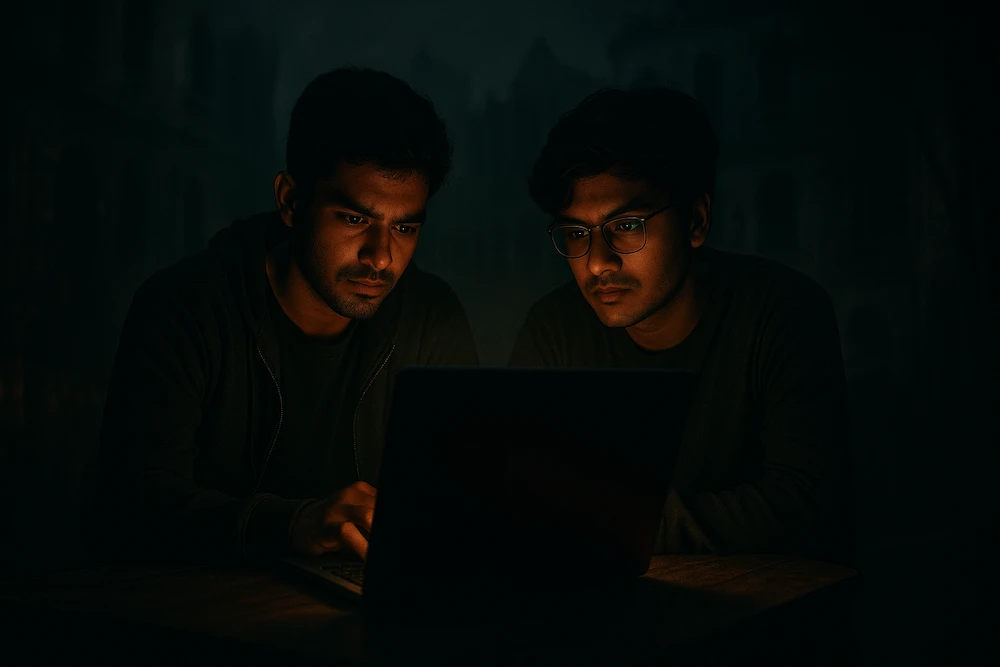
Arjun didn’t offer explanations. He simply said some places carry memories. And some memories find ways to speak.
Yaswanth returned to normal, though he never talked about the graves again. And whenever Arjun edited videos late at night, he sometimes caught a faint humming in old audio files. He never increased the volume. Some things, he felt, were better left partially heard, never fully understood.
Because the Sunken City may be abandoned, but it is not empty. And silence, in that place, was never truly silence. It was a story waiting for the right ears.