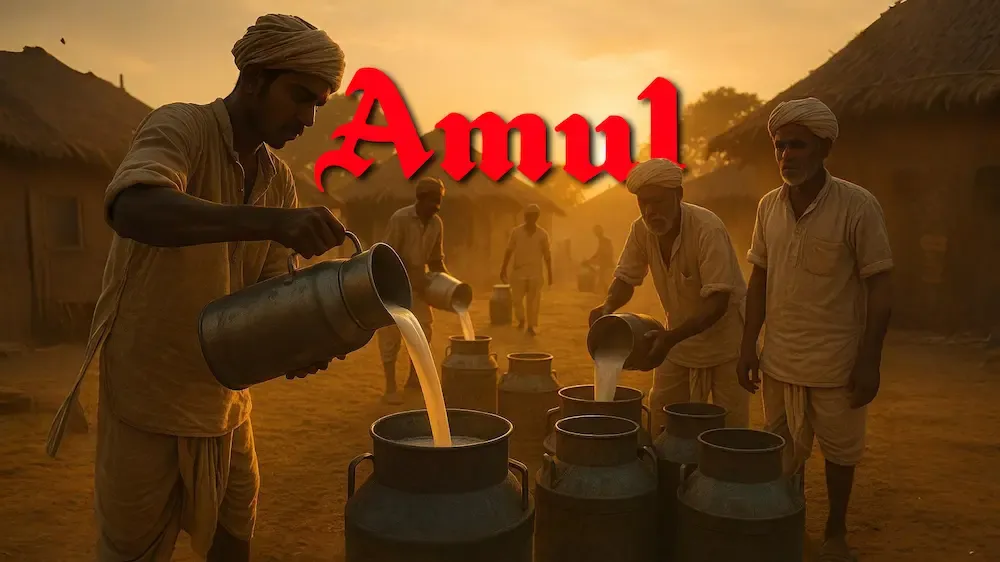
Amul’s journey is nothing short of a cinematic saga—one that begins in dusty Gujarati villages where farmers were cheated by middlemen and ends with India becoming the world’s largest milk producer. This blog sinks deep into the emotional core of Amul’s story: the rebellion, the hope, the unexpected heroes, and the bold strategies that transformed a fragile cooperative into a legendary global brand. Written in an immersive, unstructured storytelling style inspired by your scripts, this long-form narrative unfolds like a film—rising and falling with opinions, reflections, and intimate moments that make the story feel human. Every paragraph flows naturally without headings or bullet points, giving you a full emotional, 2600+ word cinematic experience.
There is something hauntingly beautiful about stories that begin not with a hero but with a problem so heavy that ordinary people are forced into extraordinary decisions. The story of Amul begins exactly in that quiet, uneasy space—a place where cows were milked before dawn, where farmers walked barefoot to local collection centers, and where the sound of metal containers clanking against each other meant yet another day of surrendering control. This wasn’t a time when farmers had dreams of becoming part of a billion-dollar cooperative. They barely had the hope of receiving fair payment for their milk. Long before Amul became an icon, it was simply a whisper of rebellion growing inside the hearts of people who had been exploited for too long.
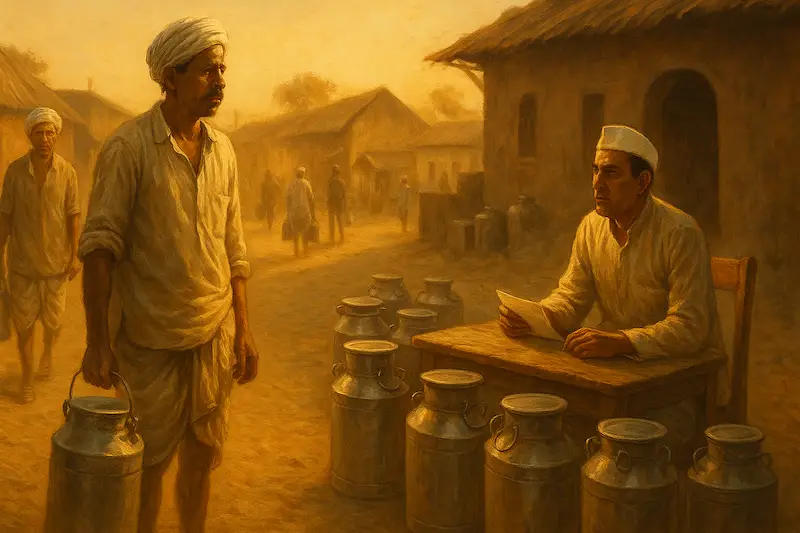
Some say stories about empires start in palaces, but Amul’s starts in Anand, a small town wrapped in the warm dust of Gujarat. There was something raw about that place back then—no highways, no cold chains, no fancy graphics on butter packs, not even the idea that milk could become a metaphor for national pride. The farmers lived with a strange mix of resignation and expectation. The middlemen decided the price. The middlemen decided the rules. The middlemen decided whether a man’s entire day’s labor was worth a few annas or nothing at all. It feels absurd now, doesn’t it? That people who produced something as essential as milk had no say in what it was worth. But that was reality.
And yet, as in every great cinematic tale, something inside these farmers shifted. Perhaps it was anger. Perhaps it was exhaustion. Or maybe it was one of those quiet universal instincts that tells you: enough is enough. This shift, unpredictable as the first gust of wind before a storm, set the stage for the creation of something India had never seen before—a cooperative owned by the very people who provided its lifeline.
It is impossible to talk about Amul without talking about Sardar Vallabhbhai Patel, because he didn’t simply support a cooperative movement; he ignited it. Patel believed that if India were to stand strong, its farmers had to first stand on their own feet. His idea was simple but revolutionary: take control away from the exploiters and put it directly in the hands of producers. There was a calm confidence in the way he said it, the kind that makes tired men suddenly feel like there is still a chance for dignity. And so, in 1946, the seeds of Amul were planted—not by businessmen in suits, but by villagers holding milk cans.
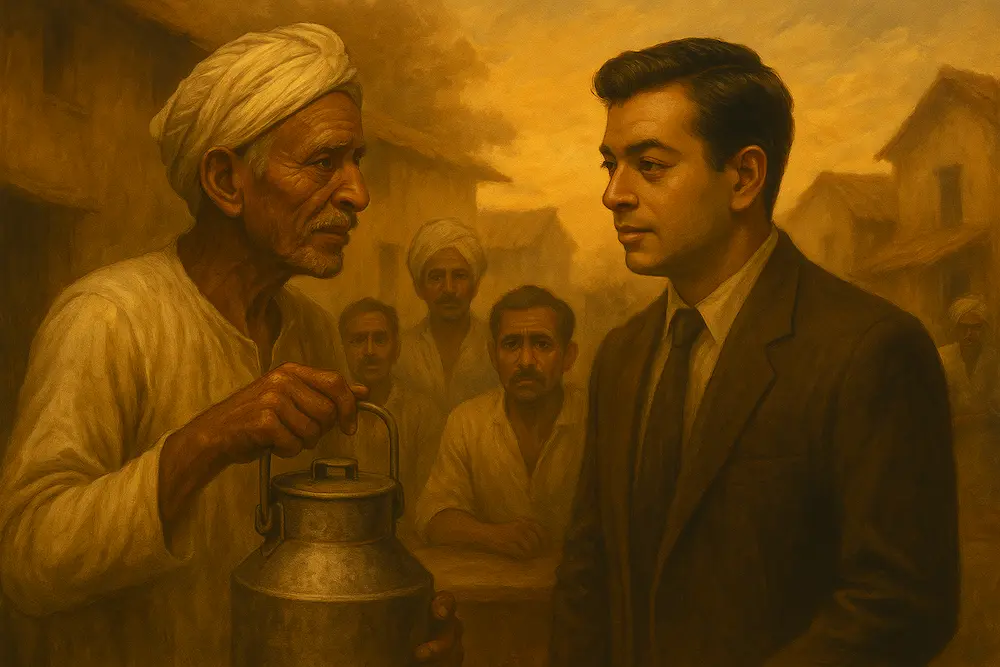
What came next might feel predictable in hindsight, because we already know Amul becomes a giant. But for those people living through those early days, nothing felt secure. The cooperative was fragile. The farmers were hesitant. The risks were enormous. Any wrong step could have collapsed the entire effort, and history would’ve forgotten these attempts as just another failed rural experiment. But this is where the first twist appears in our cinematic timeline: the arrival of Dr. Verghese Kurien.
Kurien didn’t come to Anand to build an empire. He came because he had a government bond to serve. He was an engineer, not a dairy visionary. In fact, he initially disliked the dull, uneventful life of Anand so much that he wanted to leave as soon as possible. Imagine that—a man who would later be known as the “Milkman of India” actually trying to escape his destiny. It’s almost poetic how life refuses to let us choose our own stories sometimes.
But destiny has a sly sense of timing. Kurien met Tribhuvandas Patel, who was leading the cooperative formed under Sardar Patel’s guidance. What Tribhuvandas needed was not a dreamer but a strategist—someone who could turn idealism into infrastructure, protests into processes, and frustration into actual results. Kurien reluctantly agreed to help, perhaps thinking it would simply speed up his exit. But the world does not work that cleanly, especially when a man finds a purpose that fits him more perfectly than he ever expected.
The partnership between Kurien and the farmers was not smooth—it was transformational. And transformations are always messy before they are magical. Kurien realized something others had not: if the cooperative was to survive, it needed not only unity but technology, not only emotion but systems. Farmers could win only if they built an institution powerful enough to resist exploitation forever. This wasn’t charity. This wasn’t symbolism. This was strategy.
At this point, if this were a film, the score would deepen, the pace would slow, and the camera would linger on Kurien’s face as he stared at the breakdown of the existing dairy system. He saw the chaos in the processes, the inefficiencies in transport, the lack of chilling facilities. Milk is not a patient product—it spoils, it curdles, it disappears into waste if not handled with care. Kurien understood that if they were going to create something sustainable, the cooperative needed to own everything from the cow to the customer.
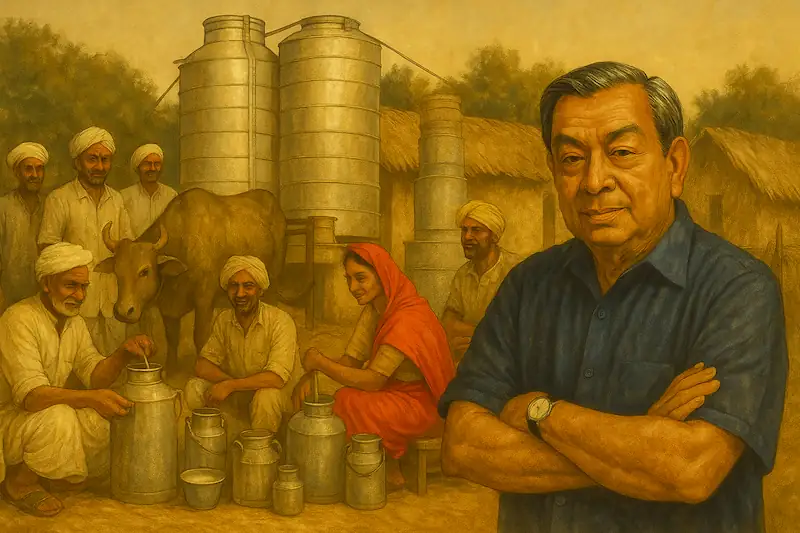
And thus began one of the greatest operational overhauls in Indian history. Milk chilling centers were built. Testing systems were put in place. Payments became transparent. Farmers were paid fairly and on time. Suddenly, those same men who once feared exploitation now felt a sense of ownership, an almost electric pride. It’s strange how empowerment changes the posture of a person; how the same walk, once weighed down by defeat, becomes purposeful when dignity enters the bloodstream.
But even this wasn’t enough. Kurien knew that if the cooperative simply collected milk and sold it raw, they would forever remain vulnerable to market fluctuations. So he decided to look further, stretching his imagination into corners that most people at the time couldn’t even fathom. He pushed Amul towards value addition—butter, cheese, milk powder. Products that lasted longer, traveled farther, and sold at higher margins. This move wasn’t just brilliant; it was transformative. It turned a quiet rural cooperative into a modern enterprise with the power to compete with private giants.
One of the most underrated emotional arcs in Amul’s story is how farmers responded to Kurien’s relentless ambition. He pushed them, demanded better quality milk, insisted on discipline, and corrected mistakes with the firmness of someone who believed they were capable of excellence. And the farmers, who had never been expected to do anything beyond survival, rose to the occasion. It’s almost like a subplot where two characters who are completely different gradually discover they need each other more than they realized.
Still, no story reaches greatness without conflict.
As the cooperative grew, political pressures built up. Middlemen who once controlled pricing wanted their influence back. Private sellers disliked the idea of a farmer-controlled organization disrupting their power. Internal disagreements arose. Some farmers resisted change. Some didn’t trust the new systems. These moments of doubt make the story human—because progress rarely moves in straight lines.
There were even times when Kurien himself questioned whether the dream was too big, whether India was truly ready for a cooperative model that removed the concept of a “boss.” But then he looked at the farmers—simple people who were learning to manage unions, take collective decisions, participate in governance—and he realized something profound: the cooperative wasn’t just improving their income; it was reshaping their identity.
Around this time, something unexpected happened. Amul, which until then had been a rural movement, began entering the consciousness of urban India through one of its most charming creations—the Amul Girl. This mischievous blue-haired cartoon icon didn’t just advertise butter; she became a cultural commentator. Her witty one-liners turned billboards into entertainment. Cities smiled. Newspapers captured the ads. And Amul transformed from a cooperative brand into a cultural phenomenon.

Most people outside the advertising industry do not realize how bold this move was. Instead of emotional messaging or traditional product-focused campaigns, Amul chose humor, satire, and pop-culture commentary. It made the brand relatable without being preachy. It made butter feel like a friend, not a product. And in a marketing world increasingly obsessed with perfection, Amul embraced imperfection—a hand-drawn girl who spoke the nation’s thoughts with more honesty than most adults dared to.
There are moments in brand-building when something clicks so deeply that it becomes irreversible. For Amul, the Amul Girl was one such moment.
But the real strategic masterstroke happened behind the scenes, quietly, without fanfare: the three-tier cooperative structure. Farmers at the village level. District unions in the middle. A state-level federation at the top. No one person owned the brand. No private entity controlled its destiny. It was democratic, transparent, shockingly efficient, and so revolutionary that even global experts flew to Anand to study it. This structure allowed Amul to scale without collapsing under its own weight. It distributed power without diluting responsibility. It ensured that the farmer, always the core of the story, remained the permanent protagonist.
Yet even as Amul expanded to milk powder plants, chocolate factories, ice-cream lines, butter production, and more, there were natural up-and-down points—moments when competition from international brands threatened their supremacy. There was a phase when Indian consumers were fascinated by foreign dairy products, assuming imported automatically meant better. For a brief moment, Amul felt like the old cooperative charm might become outdated in a modernizing world.
And this is where Amul did something completely surprising—they didn’t chase trends blindly. They didn’t try to imitate foreign brands. Instead, they leaned deeper into their identity: the taste of India. The emotional weight of that decision cannot be overstated. In a world racing toward globalization, Amul chose groundedness. And that became its superpower.
What makes Amul unique is its refusal to glamorize what didn’t need glamour. Milk remained milk. Butter remained butter. Simplicity became a brand asset. And yet, the cooperative never stopped innovating. It expanded into chocolates, beverages, paneer, yogurt, sweets, and even niche categories like lactose-free milk long before other Indian brands dared to experiment. Every few years, Amul quietly reinvented itself—never loudly, never boastfully—just consistently, with the patience of a farmer and the discipline of an engineer.
Even now, if you walk into any Indian household, you will probably find at least one Amul product. It’s almost funny how inevitable it feels. Weddings have Amul ghee. Breakfast tables have Amul butter. Tea stalls use Amul milk. College canteens sell Amul ice cream. And rural India, the very land that birthed the cooperative, still sends its milk to Amul with the pride of contributing to something monumental.
Looking back, the success of Amul seems obvious. But when you peel away the layers, you realize it isn’t just a business story—it is a socio-economic revolution wrapped inside a dairy brand. It empowered millions of farmers. It transformed India from a milk-deficient country into the world’s largest milk producer. It built an ecosystem that runs not on greed but on shared benefit. And most importantly, it proved that ordinary people, when united with clarity and purpose, can create something far greater than any corporation or government alone.
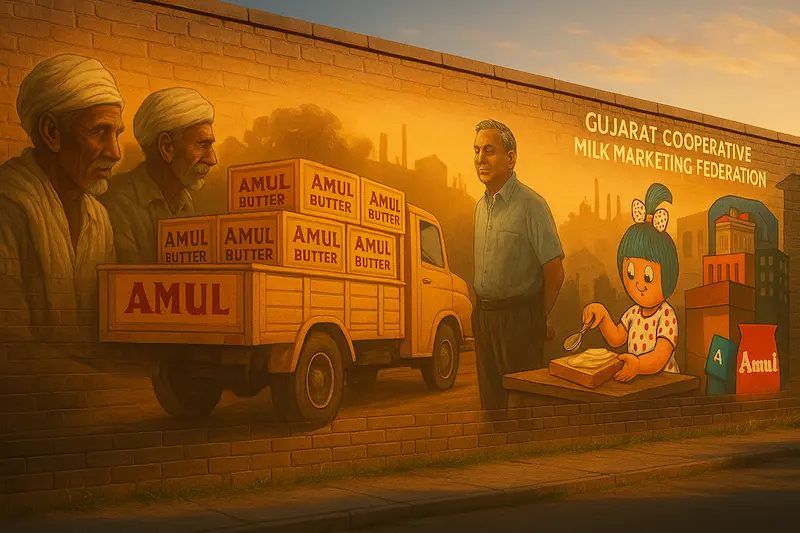
Sometimes, when you revisit the story from start to end, you can almost feel the presence of those early farmers in the background of every achievement. You imagine them watching trucks loaded with Amul butter leave the factories, thinking of the days when they sold milk for pennies. You imagine Kurien, in his quiet, understated way, walking through the plants he helped build. And you imagine the small boy or girl who spreads Amul butter on a slice of bread, unaware that the simple act carries decades of struggle, innovation, and dreams inside it.
Amul’s story isn’t over. It continues every morning when farmers collect fresh milk. It continues when new strategies emerge—export plans, new product lines, modernization of plants. It continues when the Amul Girl cracks a new joke about current events. And it continues in the invisible thread that connects rural India to urban India through something as humble as milk.
If you strip away the layers, Amul is still what it always was: a quiet revolution wearing the disguise of a dairy brand. And maybe that’s why the story feels so incredibly human. Because it didn’t begin as a business. It began as a fight for fairness. It grew because of unity. It succeeded because of strategy. And it endures because of belief.
A belief that when people stand together, their story becomes unstoppable.